 Digitoria
WhatsApp
Blog / DIGITORIA JOURNAL
Customer Personas for Small Businesses: A Practical Guide to Better Marketing
Customer personas for small businesses are simple, evidence-based profiles that help you...
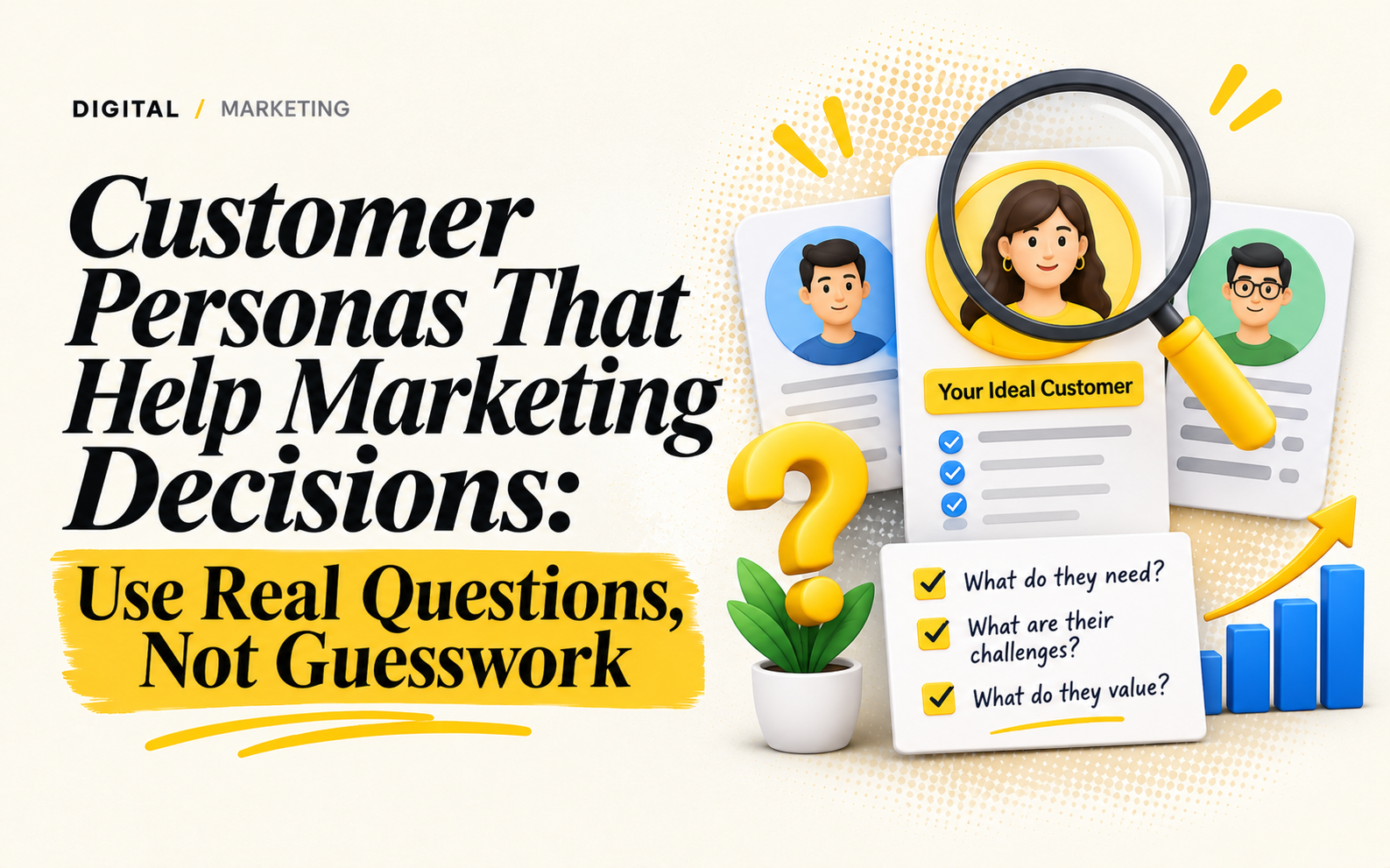
Customer personas for small businesses are simple, evidence-based profiles that help you understand who your marketing is for and what they need to decide. They are not fictional characters built from guesses. A useful persona connects real customer patterns—goals, obstacles, buying questions and preferred channels—to practical choices in your website, campaigns and content.
If a bakery, clinic, consultant or local service speaks to everyone in the same way, its message can feel generic. A focused customer persona helps a small team explain the right benefit to the right audience, without excluding people who do not fit one narrow stereotype.
What a useful customer persona includes
Customer Personas for Small Businesses: What to Include
A useful persona is a working summary of a customer group, not a made-up biography. It helps a small business make clearer choices about its message, offer, website and follow-up. Build it from recurring evidence, label assumptions honestly and update it when customer behaviour changes.
Start with evidence you already have
Review enquiry forms, sales conversations, customer support messages, repeat orders, reviews and frequently asked questions. Look for patterns in what people were trying to achieve, what prompted them to act, what alternatives they considered and what nearly stopped them. If you use analytics or search data, check that collection and use follow your privacy obligations. One unusual comment is a clue to explore, not proof that every customer thinks the same way.
Write down the source of each observation. For example: “Five recent enquiries asked whether delivery was available” is stronger than “customers probably care about convenience.” Keep observed facts separate from your interpretation so your team can revisit assumptions later.
Ask customers about decisions, not demographics
A few short conversations with recent customers can reveal useful language and unmet needs. Ask open questions such as: What was happening when you started looking? What other options did you consider? What information helped you feel confident? What almost made you wait or choose another provider? Where did you look for answers?
Listen for exact phrases and concrete moments. Avoid leading questions like “You choose us because we are affordable, right?” Do not ask for sensitive personal details unless there is a clear, lawful need. A persona should explain a buying situation and decision process, not reduce people to stereotypes.
Build one practical profile around a decision
Keep the first profile short enough to use. A simple customer persona for a local service might describe a busy owner who needs a reliable supplier before a seasonal rush. Their goal is predictable delivery; their concern is unclear pricing; their trigger is a recent delay; and the proof they need is a transparent process, realistic timelines and a clear way to get help. This is an illustrative example—replace it with evidence from your own customers.
Use a few useful fields: customer situation, goal, trigger, main question, barrier, evidence needed and preferred next step. Add a channel only when you have a reason to believe it matters. Age, job title or a fictional name alone rarely tells you what to say.

Turn the profile into better marketing
Use the customer’s real questions to improve a landing page, service description, email or social post. Put the most relevant benefit near the top, explain what is included, address a genuine concern and make the next action clear. If prospects repeatedly ask about timelines, answer that question on the page instead of hiding it in a sales call.
Then check whether the change helps. Review qualified enquiries, useful conversations, conversion actions and customer feedback—not just likes or page views. For guidance on planning research, see the US Small Business Administration’s market research and competitive analysis resources. For a broader measurement approach, read our digital marketing report metrics guide.Customer personas for small businesses help teams turn those insights into clearer messages and next steps.
Keep personas current and respectful
Personas are hypotheses that should improve with evidence. Review them when your offer, customer mix or buying process changes. Combine similar profiles when they lead to the same marketing decisions; split them only when their needs and next steps are meaningfully different. Store interview notes responsibly, get appropriate consent and avoid using a profile to make unfair decisions about individuals.
A simple template to start today
Segment: which recurring customer situation does this describe?
Goal: what outcome are they trying to achieve?
Trigger: what prompted them to look now?
Question: what do they need answered before deciding?
Barrier: what creates hesitation or friction?
Proof and next step: what trustworthy evidence and action will help?
Hinglish takeaway: person ko guess se nahi, real customer ki baaton aur behaviour se banao. Phir website, content aur follow-up mein unke asli sawaalon ka seedha jawab do. Chhota, evidence-based profile bhi kaafi useful hota hai—bas usse regularly update karte raho.
Frequently asked questions
How many customer personas does a small business need?
Start with one or two distinct customer situations. Add another only when the audience has different needs, objections or buying steps that change your marketing.Use the fewest profiles that still change a real marketing decision; customer personas for small businesses should clarify the next message rather than create extra paperwork.
Are customer personas only demographic profiles?
No. Demographics can provide context, but goals, triggers, questions, constraints and decision criteria are usually more actionable for marketing.
How can I create personas with little data?
Begin with a few customer interviews and the enquiries or reviews you already have. Mark early conclusions as hypotheses, test them in real conversations and refine the profile as evidence grows.
Customer personas for small businesses work best when they lead to a useful action: a clearer page, a more relevant message or a better customer conversation. Start small, learn from real people and keep the profile honest.